It’s very unlike Maruti Suzuki to be behind the curve, but that’s been the case when it comes to electric vehicles. While its chief rivals, such as Hyundai, Tata Motors and Mahindra, entered the EV fray years ago, India’s largest carmaker took its time, finally entering the arena with the e Vitara electric SUV. There’s plenty to unpack, so let’s dive in.
But first, a very important disclaimer before we proceed: Maruti Suzuki did not share any technical details, specifications or a feature list with us during the media drive. So a lot of this review is based on assumptions, speculation and details we gathered during our drive of the e Vitara in the UK. It’s not an ideal situation but should still give you a fair idea of what the e Vitara is about.
Maruti e Vitara exterior design and engineering – 7/10
Unconventional design that’s rugged and chunky stands out for its quirkiness.
Design is all new and unique, yet bears a distant link to other Marutis.
I think the e Vitara gets a lot right when it comes to design. It’s all about sharp lines and prominent angles, and there’s a good blend of familiar Maruti design cues and all-new elements. When viewed from up front, the e Vitara appears nice and muscular thanks to the thick plastic cladding lower down on the bumper and distinctive character lines on the bonnet. The grille is obviously blanked off in the interest of aero-efficiency, flanked by LED headlights featuring a Y-shaped DRL (daytime running lamp) signature.
Along the sides, there’s generous cladding on the lower portion of the doors and around the wheel arches, adding to its ruggedness. The India-spec car gets smaller 18-inch aero-efficient alloys compared to the 19s on the UK car. Then there’s the tapering roofline and wide haunches over the rear wheels, increasing its appeal further. While the front door handles are conventional, the rear ones are mounted on the thick C-pillar.
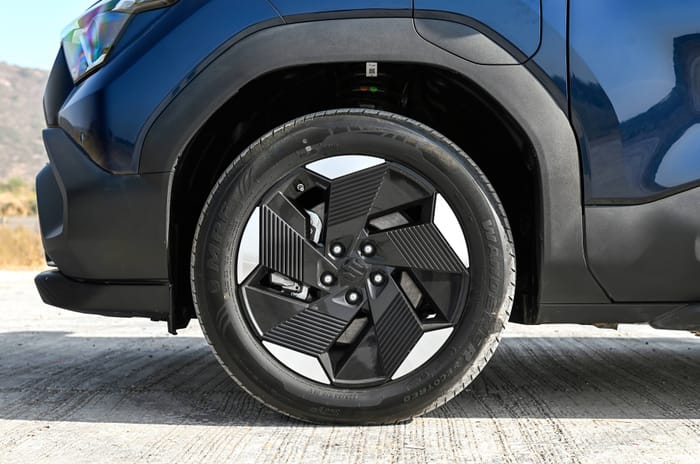
Top-spec Alpha variant gets 18-inch alloy wheels.
At the back, there’s an upright tailgate featuring the Suzuki logo and the e Vitara badge in the centre and a light bar, though it’s not illuminated. Atop the tailgate is a spoiler, while lower down, there’s a chunky bumper and a faux skid plate. The standout elements at the rear, though, are the tail-lights, which feature slim, premium-looking LED elements inside.

Prominent rear haunches define the stance, but cladding feels excessive.
The e Vitara is being made right here in India for the rest of the world. It is said to be based on an all-new EV platform called Heartect-e. However, there are certain traits that lead us to believe this is an elaborate ICE-to-EV conversion. The two-wheel-drive version, which will be the only one sold here, has its motor on the front axle, whereas most born-electric cars use a rear-mounted motor, as it’s better for packaging, driveability and safety. They also usually feature a frunk, which this doesn’t get.
As for dimensions, the UK-spec e Vitara is nearly 4.3 metres long, 1.8 metres wide and 1.6 metres tall, with a 2.7-metre wheelbase. The ground clearance is said to be a reasonable 185mm, while the UK car’s kerb weight is just shy of 1.8 tonnes, making it the heaviest Maruti Suzuki.
Maruti e Vitara interior space and comfort – 6/10
e Vitara’s interior quality is the best we’ve seen in a Maruti so far.
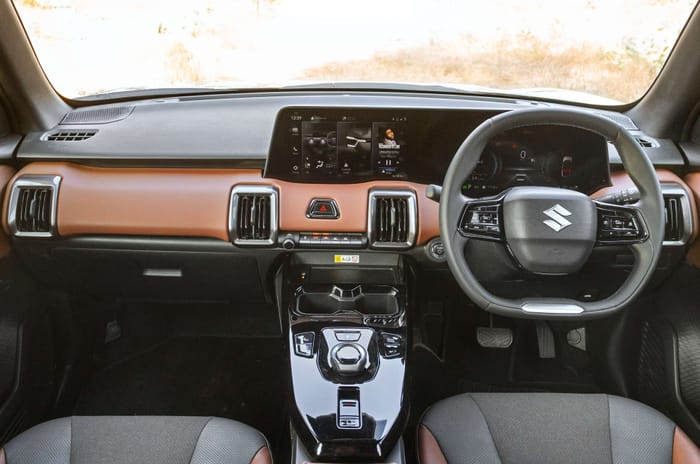
Unique design and materials the best in a Maruti yet.
The e Vitara’s interior raises the standard for Maruti vehicles when it comes to design and quality. The asymmetric dashboard features a dual-screen binnacle on top and a soft-touch brown leatherette surface in the centre, along with dark silver AC vents. The steering is a squarish, two-spoke unit that feels nice to hold, and you get proper physical controls for the AC and infotainment volume, which is nice to see. The screens, though we don’t know their exact size, are of a decent size and have a UI different from other Marutis. The asymmetric theme is carried over to the screens as well, as the touchscreen sits higher than the driver’s display, creating a massive bezel on top of the latter. Some may find this annoying, but the placement actually works, as the cluster falls directly in your line of sight and isn’t blocked off by the steering.
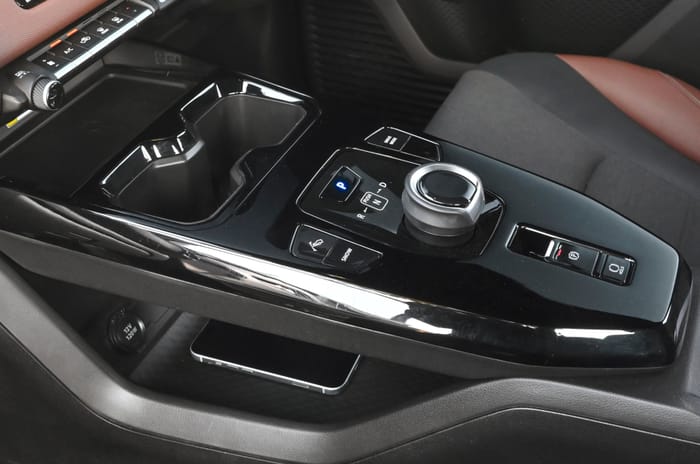
Plenty of storage spaces and cubbies, such as under the floating centre console.
Then there’s the centre console finished in gloss black, housing cup holders, a wireless charger, a drive selector and other functions. The drive selector is unique and easy to get used to, as you have to push it down for N and twist it right for D or left to go into reverse. There are plenty of storage spaces, too, such as under the floating centre console and centre armrest, door bins and a glove box. Overall, the e Vitara’s interior quality is the best we’ve seen in a Maruti.
The front seats are comfy and supportive, but the driving position takes some time getting used to, as you sit quite knees-up. A powered driver’s seat and tilt/telescopic steering do help you find your ideal position, however. In the rear seat, there’s plenty of legroom thanks to its 2,700mm wheelbase, but headroom will be tight for six-footers. The backrest reclines but is virtually upright at its furthest position, and like at the front, here too you’re seated in a knees-up position. The seat itself, though, like at the front, is well-padded and comes with adjustable headrests and three-point seatbelts for all. There’s a single-pane sunroof (which doesn’t open) up front, and coupled with slim rear windows and dark upholstery, it makes the rear of the cabin feel a bit claustrophobic.
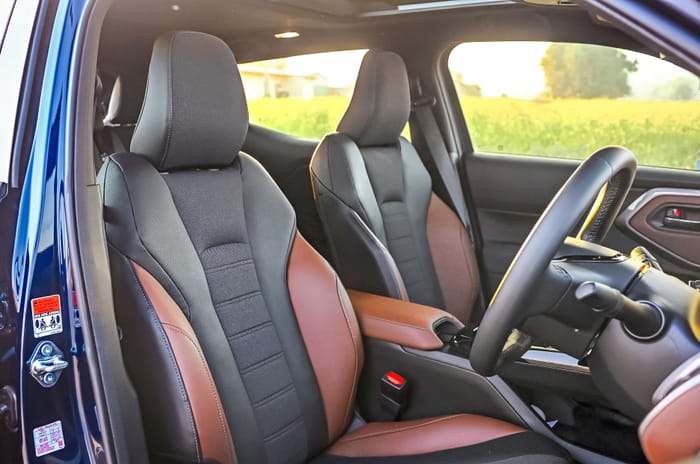
10-way power-adjustable driver’s seat is comfortable and thickly cushioned.
What’s unique is that the centre seat-back folds down to form an armrest with cup holders, but that also exposes you to the boot and whatever’s inside. The bench can be slid forward to aid cargo volume, but even then, boot space is tight. The UK-spec car has a capacity of only 238 litres with the seats all the way back, which expands to just 306 litres with them slid fully forward. The boot is also shallow, but it’s nice that you get a full-sized spare wheel underneath and a tray to store your charging cables.
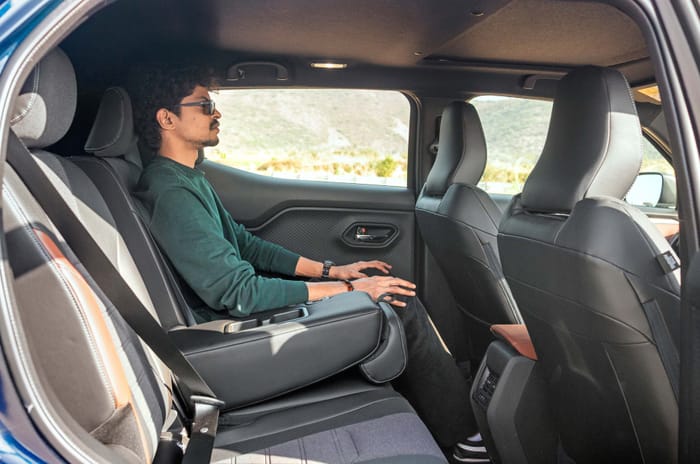
Tall passengers will find rear headroom lacking.
Maruti e Vitara features and safety – 7/10
Well-equipped but not class-leading; has 5-star Bharat NCAP rating.
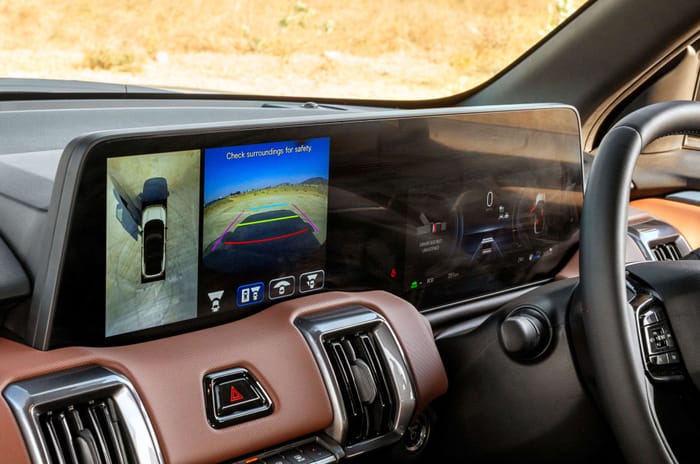
Asymmetrical dual-screen panel looks misaligned but works in practice.
Although we don’t have the full feature list yet, the test car we drove was equipped with a touchscreen around 10 inches in size, a full digital instrument cluster, wireless smartphone interface, single-zone climate control, a 360-degree camera (whose clarity was poor), a single-pane fixed glass roof, a wireless phone charger, a powered driver’s seat, ventilated front seats (controlled via the touchscreen), an Infinity-branded audio system with a subwoofer and leatherette upholstery. However, compared to rivals, it does miss out on features such as a panoramic sunroof, dual-zone climate control and a powered tailgate.
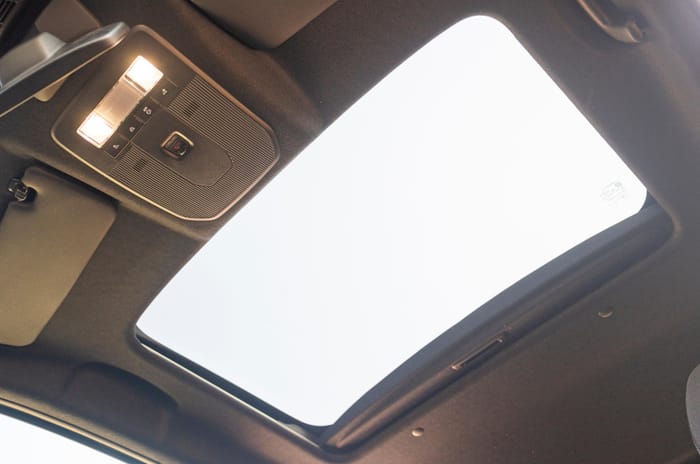
An electrically operated single-pane sunroof is on offer.
As for safety, we could tell it has at least 6 airbags, ESC, traction control and Level 2 ADAS tech, such as autonomous emergency braking, lane-keep assist, adaptive cruise control, and much more. In our short drive, we could tell that the ADAS tech has been well-calibrated for our conditions: the AEB doesn’t cut in too early, the lane-keep assist isn’t aggressive, and the adaptive cruise control also keeps a safe distance from the vehicle ahead. The e Vitara has also received a 5-star safety rating from Bharat NCAP.
Maruti e Vitara performance and refinement – 7/10
Smooth but strong acceleration; too much road noise enters cabin at speed.
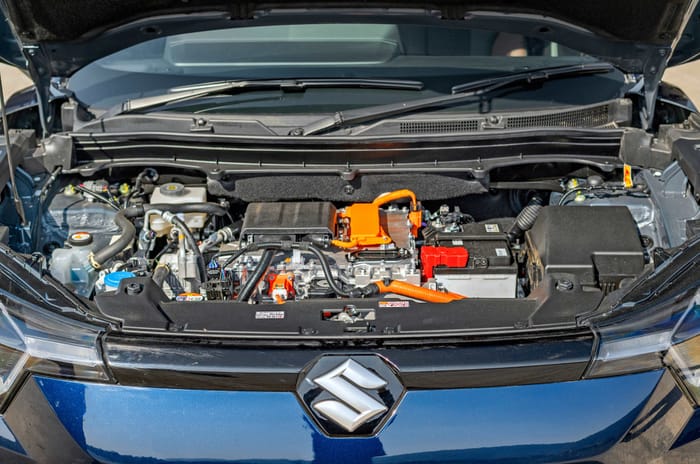
Powertrain has been tuned for drivability rather than performance.
Given the lack of information on specs, we had to assume a lot of the details using the UK-spec car for reference, and given that manufacturers usually provide test cars in their highest spec, we assumed we were driving the 174hp version with the larger 61kWh battery. There will also be a 144hp version with a smaller 49kWh battery on sale. An all-wheel-drive version is also on sale abroad, but that is unlikely to make it to our market.
It becomes clear quite soon that this powertrain has been tuned for drivability rather than outright performance. From a standing start, it doesn’t have the neck-snapping acceleration usually associated with EVs, and instead, it builds speed in a very linear and progressive manner. It’s in the city where this characteristic shines, as the e Vitara feels smooth and easy to drive, with no sudden spikes in power delivery. But that’s not to say that it lacks in terms of performance, as we managed to clock a 0-100kph time of 9.25 seconds, which is reasonable and on par with the Tata Curvv EV.
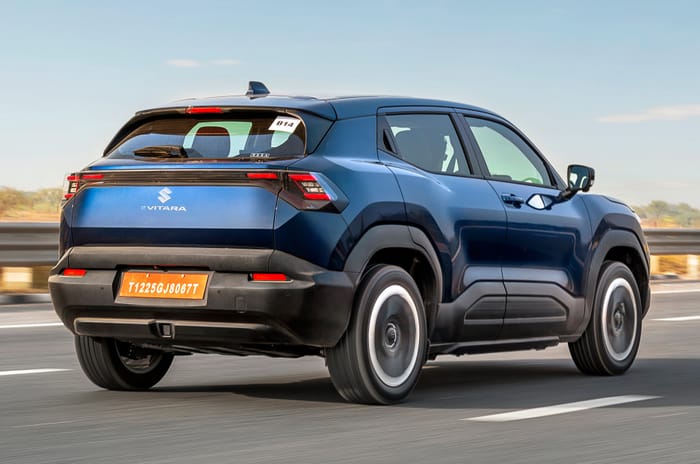
Road and wind noise quite prominent at highway speeds.
Maruti has also packed three drive modes – Eco, Normal and Sport – which have a corresponding effect on the powertrain’s response, but not by much. Eco mode feels a little too dull and is best reserved for low-speed city driving, whereas Normal mode feels the nicest, and it’s in this mode where you’d want to be most of the time. Sport mode feels a bit more urgent than Normal, but it’s not a big difference. On the whole, the e Vitara feels easy to drive, especially in the city, and it has a decent reserve of power whenever you need it.
What definitely needs improvement is the refinement. There’s very little motor whine audible inside, but at higher speeds and especially over concrete road surfaces, there is a lot of wind and tyre noise. The e Vitara needs better insulation, as the noise gets annoying quite quickly, especially given the lack of an engine’s NVH to mask it.
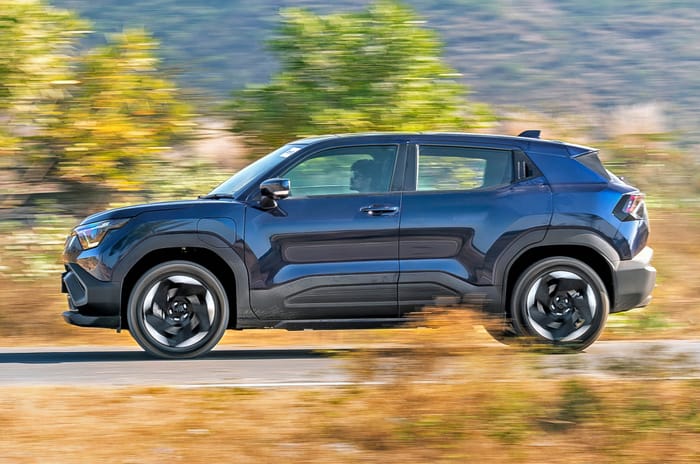
Firm ride quality and can get easily unsettled on a poor surface.
Thanks to disc brakes all around, stopping power is more than ample. There are levels of regenerative braking, too, but the way you cycle through them is quite odd and inconvenient. First up, there are no paddleshifters to adjust the levels on the go, with only a single button in the centre console. And even then, that button only switches on/off the preset level that you have chosen. If you want to cycle through the different levels, you have to do it through the touchscreen, which can only be done while stationary.
Maruti e Vitara efficiency and charging – 8/10
Maruti says the larger 61kWh battery will do 543km on a single charge.
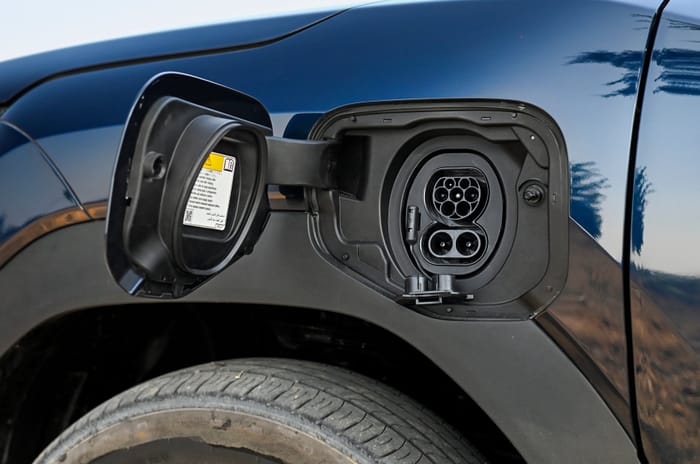
Charging port located on the front fender.
With this being a short drive, we didn’t get a chance to subject the e Vitara to our real-world range tests, but the on-board computer displayed an efficiency of 4.8km/kWh on the highway, which isn’t great. However, in city driving conditions – where EVs generally excel – it displayed an impressive 7km/kWh. The manufacturer, meanwhile, claims that the e Vitara with the larger 61kWh battery will do 543km on a single charge.
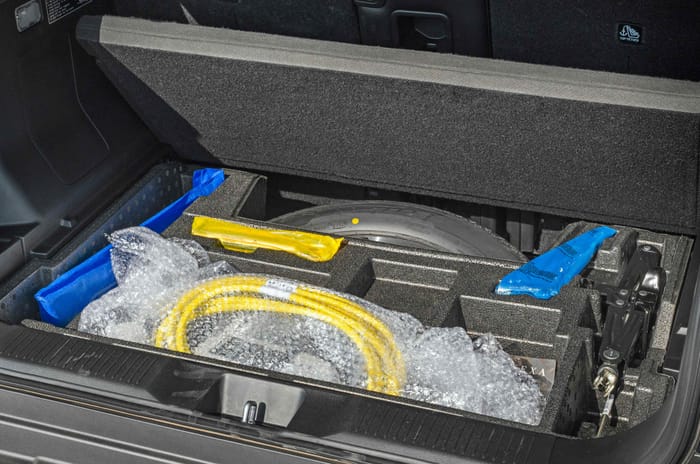
There’s a full-sized spare and a tray to store charging cables under the boot.
As for charging, the UK-spec car with the 61kWh battery can be topped up from 10 percent to full in 5 hours and 30 minutes using an 11kW AC charger and from 10 percent to 80 percent in 45 minutes when using a 70kW DC fast charger.
Maruti e Vitara ride comfort and handling – 6/10
Firmly sprung e Vitara gets easily unsettled at highway speeds.
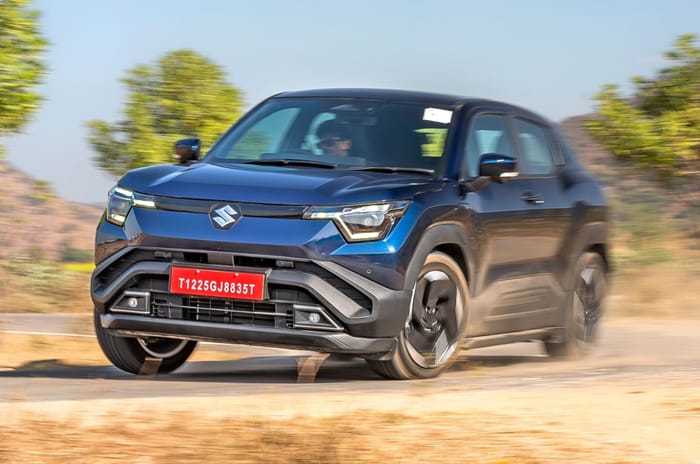
There is noticeable body roll in the corners; this is not a sporty EV.
The e Vitara’s suspension has been set up with that underlying firmness usually associated with European cars, so at low speeds, you can feel sharp bumps and big potholes prominently in the cabin. Still, it’s not uncomfortable until you get to highway speeds, where the e Vitara feels unsettled, and the suspension feels too busy. There’s considerable vertical and side-to-side movement, especially over expansion joints, and it may leave your passengers feeling queasy over long distances.
The handling, in typical Maruti fashion, is best described as safe but unexciting. There is noticeable body roll, and the light steering doesn’t inspire much confidence around bends, though there’s a decent amount of grip; acceptable for a midsize electric SUV.
Maruti e Vitara price and verdict – 6/10
Gets the basics right, but the bar has already been set much higher.
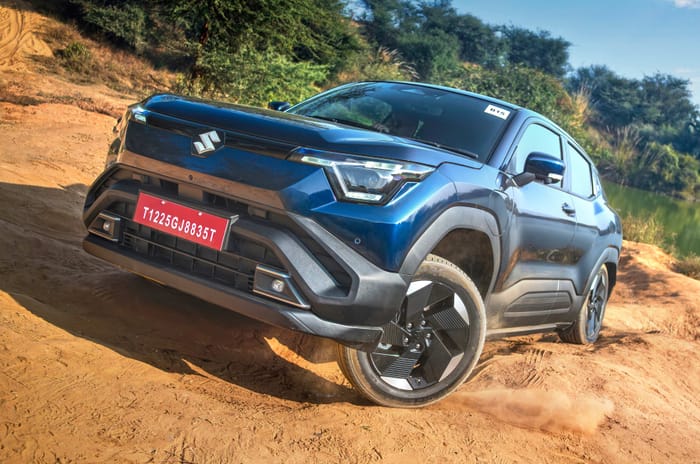
Given our brief drive and the lack of official information, we can’t give the e Vitara a full and final verdict, but what we do know is that it will be sold through the Nexa retail channel and offered in two battery sizes and three trim levels – Delta, Zeta and Alpha.
The e Vitara does have its flaws, such as limited rear-seat headroom and boot space, knees-up seating position, busy ride and evident road and tyre noise. Given how late it is to the market, Maruti really should have addressed some of these issues before launch.
But there’s quite a bit it gets right, too. The powertrain is smooth and progressive, offering decent performance, and initial signs say it’s efficient as well. It’s also easy to drive thanks to its light steering, and its out-of-the-box design is also uniquely attractive.
The final missing piece of the puzzle is the price, on which this EV’s very positioning hinges, and if Maruti can be disruptive here as it has in the past, it stands a chance of playing in a different segment entirely. On the whole, the e Vitara gets the basics right, but it still has its work cut out given the established competition it is up against.